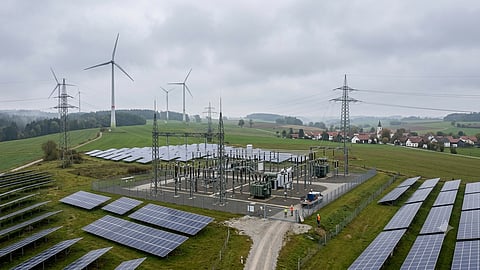

Germany has proposed reforms to its renewable energy support framework to ease grid congestion and lower energy transition costs, drawing criticism from industry groups.
Germany’s government has proposed sweeping reforms to its renewable energy support framework, seeking to reduce incentives for new solar and wind projects in grid-constrained regions as part of efforts to lower the cost of the country’s energy transition.
The proposed changes include reduced support for small-scale rooftop solar installations and lower compensation for utility-scale renewable energy projects that are curtailed due to grid congestion. The reforms have been circulated to industry associations and federal states for consultation ahead of their planned implementation.
The government is required to revise the Renewable Energy Act (EEG) before the current funding framework expires at the end of 2026, partly to comply with new European Union state aid rules that will require windfall profit clawback mechanisms from 2027. While priority grid access has long supported Germany’s renewable energy expansion, transmission infrastructure has struggled to keep pace with the rapid growth of wind and solar capacity.

Under the proposed reforms, new renewable energy projects in areas experiencing grid bottlenecks would receive automatic grid connections only if developers agree to waive compensation for curtailment. However, compared with earlier proposals, the government has relaxed some provisions by raising the congestion threshold from 3% to 5% of annual electricity that cannot be injected into the grid. The period during which projects must forgo remuneration for curtailed generation has also been reduced from ten years to six years, while uncompensated curtailment would be capped at between 10% and 20% of annual electricity production.
For small rooftop solar systems, the government proposes retaining feed-in tariffs during the first three years of operation from 2027, although at lower rates than those currently available. Support would then gradually decline until 2030 rather than being removed immediately, as suggested in earlier proposals.
The proposed reforms have drawn strong criticism from renewable energy industry bodies, including the German Renewable Energy Federation (BEE) and the German Solar Association (BSW-Solar), which warned that the measures could jeopardise billions of euros in investment and threaten thousands of jobs. They also criticised the three-day consultation period as inadequate for legislation with far-reaching implications.
The reforms form part of Economy Minister Katherina Reiche’s strategy to improve the cost efficiency of Germany’s energy transition by aligning renewable energy deployment with available grid capacity. While the renewable energy industry supports efforts to improve system efficiency, it argues that the proposed changes could slow the pace of wind and solar deployment.
Germany aims to generate 80% of its electricity from renewable sources by 2030. The federal cabinet is expected to consider the proposed reforms on July 29 before forwarding the legislation to parliament.