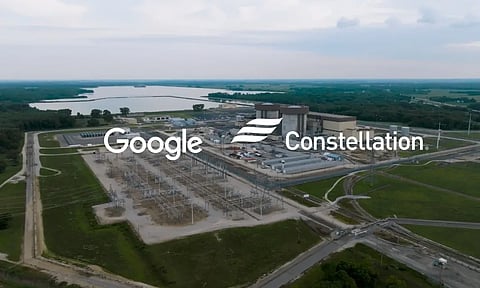
Google has signed a long-term power agreement with Constellation Energy covering 3,590 MW of electricity in the PJM Interconnection region, combining new nuclear capacity with a separate supply arrangement for existing generation. The agreement is designed to address rising electricity demand from data centers while adding firm, carbon-free capacity to the grid.
The most distinctive element is a 20-year power purchase agreement supporting 890 MW of additional nuclear capacity. Constellation will upgrade 11 nuclear units across six operating sites in Illinois, Pennsylvania and New Jersey by improving turbines, steam generators and digital control systems. The company plans to invest more than $4.3 billion in the upgrades, with the first additional capacity expected to reach the grid in 2028
Rather than developing a new nuclear plant, the arrangement uses uprates at existing facilities to increase output from infrastructure that is already connected to the grid. Google and Constellation say the additional 890 MW is equivalent to the output of a large new nuclear reactor, while avoiding some of the lengthy development and interconnection requirements associated with greenfield generation.
The remaining 2,700 MW is covered by a separate 15-year energy supply agreement within the PJM market. Unlike the nuclear component, this power is not linked to a particular generating facility. The structure provides Constellation with long-term revenue certainty for its operating generation fleet while allowing Google to secure additional electricity as its data center load grows.
The agreement also goes beyond electricity procurement. Google Cloud and Constellation have expanded their technology partnership for five years, with Gemini Enterprise and AI-enabled workflows intended to support power-flow modeling, site selection, permitting, interconnection planning, asset-health monitoring and outage management. The companies are also examining AI applications for protecting operational technology networks supporting critical grid infrastructure.
Demand flexibility is another component of the arrangement. The agreement incorporates load-shaping and demand-response capabilities that can reduce non-critical electricity consumption during periods of grid stress. This is particularly relevant to PJM, where data center expansion has contributed to rapidly increasing demand and tighter capacity conditions.
Google and Constellation are also establishing a broader framework to evaluate additional clean generation, energy storage and demand-response projects across the United States, with an initial focus on PJM. This could allow future data center growth to be paired with additional generation and flexibility resources rather than relying solely on existing grid capacity.
The agreement is expected to sustain about 4,400 existing jobs across the affected nuclear sites and support approximately 7,200 construction jobs during the upgrade program. For Google, the deal adds to a broader strategy of securing firm clean electricity for its expanding digital infrastructure, while for Constellation it creates a long-term commercial mechanism for investing in additional output from its existing nuclear fleet.