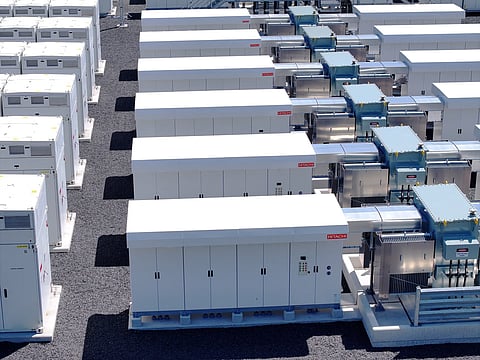

The Waratah Super Battery in New South Wales has reached full commercial operation at its rated 850 MW power capacity and 1,680 MWh energy storage capacity, marking a major milestone for Australia’s grid-scale storage sector. The project received approval from the Australian Energy Market Operator (AEMO) to operate at full capacity on September 28, 2026.
The project is more than a standalone battery installation. Its defining feature is its integration with Transgrid’s System Integrity Protection Scheme (SIPS), which monitors 36 transmission lines in real time and can automatically respond to major network disturbances. When a transmission fault or overload occurs, the control system can instruct the battery to inject power while paired generators reduce output, helping maintain the stability of the network.
At maximum output, the battery can deliver 850 MW for about two hours. The NSW Government estimates that this output could supply electricity equivalent to the peak demand of up to 340,000 households. Its primary role, however, is not simply to provide bulk electricity for extended periods. The system is designed to respond rapidly during network contingencies and increase the amount of power that can move through existing transmission infrastructure.
This creates a distinctive alternative to building new transmission capacity for every emerging constraint. The SIPS allows existing lines to operate at higher utilisation under normal conditions while keeping battery capacity available to respond if a critical transmission element fails. The project is therefore being used as a grid asset that combines energy storage, automated controls and transmission management.
The battery is located at the former Munmorah coal-fired power station site, around 100 km north of Sydney. Reusing the former industrial site provided proximity to existing transmission infrastructure and the Munmorah substation, reducing the need for a completely new grid connection route. Construction of the battery began in May 2023 and was completed in October 2024, followed by testing and staged commissioning.
The project had already entered partial operation in 2025, initially providing 350 MW of SIPS service. Its path to full capacity was affected by the failure of one of its three high-voltage transformers in October 2025. A second transformer was also temporarily de-energised as a precaution while investigations and testing were carried out. The subsequent restoration and testing enabled the project to progress to its full 850 MW operating capability.
Hitachi Energy supplied and commissioned 288 power conversion systems and two power plant controllers for the battery. These systems form the power-conversion and control architecture that enables rapid interaction between the storage system and the electricity network. Hitachi has also provided its HMAX Energy monitoring and analytics platform under a 20-year service agreement for continuous performance monitoring and predictive maintenance support.
The project attracted more than A$1 billion in private investment and involved about 1,000 people across design and construction. Akaysha Energy developed, built, owns and operates the battery, while EnergyCo commissioned the project on behalf of the NSW Government and Transgrid serves as the network operator.
The full-capacity milestone also has wider significance for renewable integration in NSW. The battery can absorb or discharge electricity according to grid requirements, while its SIPS function helps manage transmission constraints as renewable generation expands and ageing coal-fired generation retires. The project is intended to provide this role until the Hunter Transmission Project increases network transfer capability.
The Waratah project demonstrates a different approach to large-scale BESS deployment, where storage is designed as part of the transmission system rather than solely as an energy-arbitrage asset. Its combination of 850 MW of storage, automated protection, paired generation and existing transmission upgrades makes it a notable example of how batteries can be used to increase grid resilience and unlock additional renewable power without relying exclusively on new transmission corridors.