
The issue has implications beyond competition between European and Chinese turbine manufacturers. Wind farms are long-term infrastructure investments, and their operating systems remain connected to electricity networks throughout their service lives. As Europe adds renewable generation and expands its grids, decisions about remote access, software maintenance, data storage and supplier dependencies are becoming part of energy security policy. The eventual effect on wind projects will depend on the final Cybersecurity Act, its implementation and any sector-specific measures adopted by EU authorities.Vestas Group President and CEO Henrik Andersen has called on the European Union to impose stricter controls on foreign software and software-enabled components used in critical energy infrastructure, raising cybersecurity and technology-control concerns as the region expands its renewable power capacity. Speaking to Reuters at Vestas' headquarters in Copenhagen on November 16, Andersen argued that Europe must retain control over the digital systems operating its energy assets. He said wind turbines installed today could remain in service for 30 to 50 years, making decisions about software access and long-term operational control particularly significant.
Andersen's position goes beyond where wind turbines are manufactured. He proposed that approximately half of Europe's wind assets should be produced within the region, while turbine control systems and software should be assessed separately from the manufacturing requirement. His argument is that the physical origin of a turbine does not, by itself, determine who can access its operational technology, monitor its performance or issue software updates. For critical infrastructure, he wants European authorities to scrutinise components with software capabilities and the parties that retain access to them.
The concern centres on the digital functions embedded in modern wind turbines. Sensors collect operating information, control systems regulate turbine performance, and software updates can modify how equipment functions. Remote monitoring and maintenance are also important to operators and manufacturers. If access credentials or update permissions are controlled externally, the operator may face security and operational risks. Andersen argued that control over usernames, passwords and system access should remain with the parties responsible for protecting Europe's infrastructure.
He also pointed to restrictions Vestas has encountered in China. According to Andersen, Chinese authorities prevented the company from remotely monitoring sensors on its own turbines and updating their software from Europe, citing potential risks to the country's electricity grid. He argued that European companies should receive comparable treatment in overseas markets and said Vestas should have fair access to China if European markets remain open to competition. However, he clarified that he was not advocating a blanket prohibition on all Chinese components.
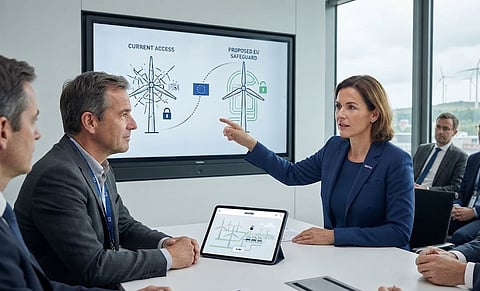
The remarks come as the European Commission seeks to strengthen the security of technology supply chains through its proposed revision of the EU Cybersecurity Act, presented on January 20, 2026. The proposal introduces a common framework to address risks associated with information and communication technology suppliers from third countries, including concerns involving foreign interference and critical dependencies. It envisages a harmonised, proportionate and risk-based approach rather than treating all suppliers or products in the same way. The proposal is still subject to the EU legislative process and should not be interpreted as an existing ban on Chinese wind technology.
The Commission's proposal also distinguishes technical cybersecurity certification from wider supply-chain risks. Its proposed framework would allow authorities to consider risks linked to supplier ownership, control and potential foreign interference, alongside technical vulnerabilities. This is relevant to wind power because turbines are increasingly connected to digital monitoring and control systems and are integrated into electricity networks. The proposal does not specifically announce a wind-sector exclusion of Chinese suppliers; its broader framework could, however, have implications for technology used in critical energy infrastructure.
The debate has also drawn a response from China's wind industry. Ming Yang, a Chinese turbine manufacturer, told Reuters that turbine data from its European operations is stored locally and that operators retain control, with remote access requiring their explicit approval. The company said cybersecurity requirements should apply equally to suppliers and favoured supplier-specific assessments and verifiable safeguards over exclusions based solely on national origin. Its position highlights the competing approaches in the debate: restricting access based on identified supply-chain risks or assessing each supplier's security arrangements individually.
The issue has implications beyond competition between European and Chinese turbine manufacturers. Wind farms are long-term infrastructure investments, and their operating systems remain connected to electricity networks throughout their service lives. As Europe adds renewable generation and expands its grids, decisions about remote access, software maintenance, data storage and supplier dependencies are becoming part of energy security policy. The eventual effect on wind projects will depend on the final Cybersecurity Act, its implementation and any sector-specific measures adopted by EU authorities.