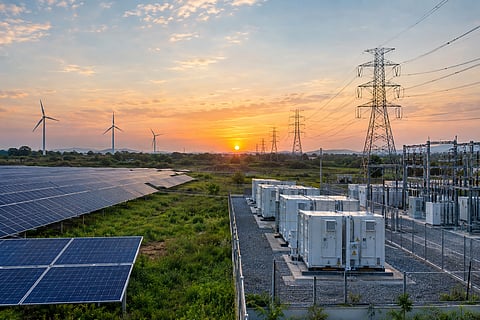
The Union Cabinet has approved Green Energy Corridor Phase-III, also identified as PM-DHARA, with a total outlay of ₹1,86,405 crore to strengthen India's intra-state transmission network and enable evacuation of up to 135 GW of renewable energy across states and Union Territories. The scheme is targeted for completion by FY2032-33.
The scale of the transmission buildout is a key feature of the programme. The initiative is expected to add 51,126 circuit km of transmission lines and 2,28,903 MVA of substation capacity. This infrastructure is intended to bring transmission capacity ahead of renewable generation, reducing the risk that new solar and wind projects face grid constraints after commissioning.
The financial structure combines transmission investment with a dedicated storage component. Of the overall outlay, ₹1,36,378 crore is allocated to intra-state transmission systems, while ₹50,000 crore is earmarked for 50 GWh of battery energy storage systems. The Centre will provide ₹54,082 crore in financial support, with the assistance intended in part to offset intra-state transmission charges and contain the impact on electricity costs.
The BESS component is particularly significant because it is integrated into the transmission programme rather than treated solely as a separate storage initiative. Storage can be deployed at renewable energy developer or generator ends, or at other locations important for grid flexibility. The government expects the systems to help manage renewable intermittency, transmission congestion, peak-hour curtailment and electricity demand during non-solar hours.
The implementation model also creates a defined role for private transmission developers. Greenfield intra-state transmission projects will be awarded through Tariff Based Competitive Bidding, with selected Transmission Service Providers responsible for building, owning, operating and maintaining the assets. Brownfield network upgrades and strengthening works will follow a Cost Plus Basis, while State Transmission Utilities will serve as the overall implementing agencies.
The programme is designed to support India's longer-term expansion of non-fossil electricity capacity. The Cabinet has linked the corridor to the objective of reaching 900 GW of installed non-fossil capacity by 2035. The combination of transmission expansion and storage is intended to improve the grid's ability to absorb renewable electricity as generation grows across geographically dispersed locations.
The approval also marks a larger shift in India's renewable-energy infrastructure priorities. Earlier Green Energy Corridor phases focused on dedicated transmission development for renewable-rich states, while Phase-III combines a much larger intra-state network expansion with a dedicated 50 GWh storage provision. The effectiveness of the new programme will ultimately depend on timely project bidding, construction, grid connectivity and coordination between State Transmission Utilities and renewable developers.
For the renewable sector, the development addresses a constraint that extends beyond generation capacity. Adding solar and wind projects does not by itself guarantee that their electricity can reach consumers when the grid lacks sufficient evacuation capacity. By pairing new transmission infrastructure with storage, the latest corridor is intended to improve renewable power utilisation while giving state grids greater flexibility to manage changing generation patterns.