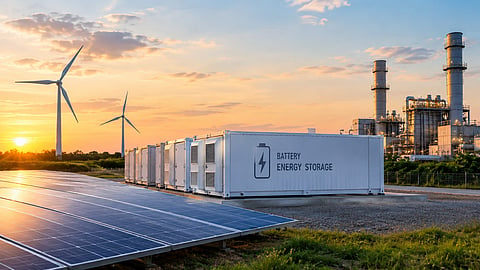

Four-hour battery energy storage systems (BESS) have become less expensive than open-cycle gas turbines (OCGTs) across all 43 markets assessed in Wood Mackenzie’s latest levelized cost of electricity analysis. The October 8, 2026, report points to a shift in the economics of supplying electricity during periods of peak demand, driven by declining storage costs, limited gas turbine availability and fuel-price volatility. The finding applies specifically to the modeled comparison with open-cycle gas turbines, which are commonly used to provide flexible power when demand rises.
A four-hour BESS is designed to discharge its rated power for approximately four hours. Its role differs from that of a gas turbine: rather than generating electricity from fuel, the battery stores electricity produced earlier and releases it when required. Its overall economics depend on the cost of charging electricity, system efficiency, cycling frequency, degradation, installation costs and the value of the power delivered. The comparison is therefore most relevant to short-duration flexibility and peak supply, rather than every role served by gas-fired generation.
The cost shift reflects pressure on both technologies. Expanding battery manufacturing and supply-chain scale are helping storage compete, while gas turbine shortages and volatile fuel prices are increasing the cost of peaking generation. Rising electricity demand from data centers is also tightening the supply of gas-generation equipment in North America. Wood Mackenzie expects these constraints to support the case for storage and renewable energy, although regional policies, tariffs and local installation costs continue to influence project economics.
The regional outlook shows that storage costs are not falling uniformly. In the Middle East and Africa, Wood Mackenzie estimates four-hour storage at US$120/MWh in 2026 and forecasts a 33% decline to US$80/MWh by 2035. In Asia Pacific, China’s grid-scale storage benchmark is more than 55% below the regional average of US$134/MWh, reflecting domestic supply-chain integration and manufacturing scale. The report projects the wider Asia Pacific average to fall to US$92/MWh by 2036, while Japan, Australia and the Philippines are expected to retain cost premiums due to factors including import duties and installation expenses.
The finding does not mean batteries can replace gas turbines in every operating condition. Four-hour systems have a finite discharge duration and must be recharged, so their ability to meet extended periods of low renewable generation depends on charging availability, grid conditions and the duration of the shortfall. Gas-fired plants can provide dispatchable generation when fuel and equipment are available. Utilities must therefore assess storage alongside other resources based on reliability needs, operating duration and the services required from the grid.
For renewable energy markets, the result strengthens the economic case for pairing batteries with solar and wind projects, shifting electricity toward peak-demand periods and providing grid flexibility. The commercial outcome will depend on local power prices, project financing, battery life, market rules and the availability of low-cost charging electricity. Wood Mackenzie’s comparison marks an important cost milestone for four-hour storage, but investment decisions will still need to account for each market’s operating requirements.