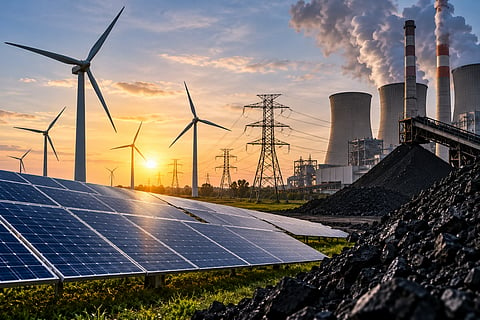

India curtailed approximately 1.835 billion units of renewable electricity during July and August 2026, despite rising power demand and declining coal inventories at thermal power stations. The Centre for Research on Energy and Clean Air (CREA), in its quarterly energy assessment released on October 12, reported that the curtailed electricity comprised 1,462 million units of solar power and 373 million units of wind generation. The findings highlight a growing mismatch between renewable generation, transmission availability and the power system’s ability to absorb electricity when it is produced.
Solar power accounted for most of the curtailed electricity, with approximately 4.2% of total solar generation in July and August unable to enter the grid. The problem persisted during a period of strong electricity demand. India’s peak demand reached 270 GW on July 16, 2026, around 18% above the peak recorded in the corresponding quarter a year earlier. Electricity generation for the second quarter of FY2026-27 rose 11% year on year to 536 billion units, according to CREA.
Transmission limitations and grid-operational constraints are central to the problem. Renewable plants may be capable of generating electricity, but inadequate evacuation capacity can prevent that output from reaching consumers. In October, MNRE Secretary Santosh Kumar Sarangi said delays in transmission-line development were a primary reason for renewable power curtailment, rather than evidence that India had built more renewable capacity than required. He also pointed to battery storage as a way to shift solar electricity into evening and night-time periods, potentially improving the use of existing transmission infrastructure.
The curtailment coincided with pressure on coal supplies, which remained essential to meeting electricity demand. Coal-fired generation continued to provide roughly two-thirds of India’s electricity during the quarter, while hydropower output fell 20% year on year, according to CREA. As of October 7, 107 of the 191 thermal power stations monitored by the Central Electricity Authority had coal stocks sufficient for zero to five days. The Coal Ministry reported that supplies had improved from September levels and that the rate of stock depletion had slowed, while cautioning that stock rebuilding had not yet begun.
The juxtaposition exposes a challenge beyond adding new generating capacity. Renewable electricity that cannot be transmitted or absorbed offers no immediate relief to supply shortages, while coal-dependent generation remains vulnerable to fuel logistics and lower hydropower availability. The issue also affects project economics because curtailment can reduce the electricity developers are able to sell, weakening expected revenues from commissioned renewable assets.
Addressing the mismatch requires transmission infrastructure to be completed in step with renewable project development, alongside better grid management and energy storage. Co-located battery systems can store surplus daytime solar generation and release it when demand rises, while standalone storage can help manage congestion and peak loads at suitable grid locations. The scale of the benefit will depend on storage deployment, charging availability, grid conditions and project costs.
India’s renewable expansion is therefore facing a system-integration test. The immediate priority is not only to build more solar and wind capacity, but to ensure that the electricity generated can be delivered when and where it is needed. Reducing curtailment could improve the value of existing clean-energy assets while easing pressure on conventional power generation during periods of high demand.