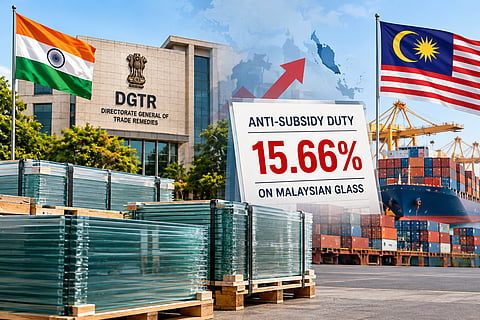

India’s Directorate General of Trade Remedies (DGTR) has recommended countervailing duties of up to 15.66% on clear float glass imported from Malaysia, following an investigation into subsidies received by Malaysian producers and their impact on India’s domestic glass industry. The final findings, dated September 28, 2026, recommend duties for five years from the date of the Central Government’s official notification. The recommendation is not, by itself, confirmation that the duties have been imposed.
The recommended rate differs by producer. Xinyi Energy Smart (Malaysia) Sdn. Bhd. faces a proposed duty of 11.61%, Kibing Group (M) Sdn. Bhd. 11.44%, and Jinjing Technology Malaysia Sdn. Bhd. 8.58%. A residual rate of 15.66% is proposed for other Malaysian producers and exporters covered by the findings. Under the lesser-duty rule, DGTR recommends rates based on the lower of the subsidy margin and injury margin. The proposed duty is calculated as a percentage of the cost, insurance and freight (CIF) value of the imports.
The investigation covers clear float glass with nominal thicknesses from 4 mm to 12 mm, inclusive, in accordance with BIS 14900:2000, as amended. The findings list customs tariff headings 7003, 7004, 7005, 7007, 7008, 7009, 7013, 7015, 7016, 7018, 7019 and 7020. The product description, rather than the tariff classification alone, determines the scope of the measure.
DGTR’s import analysis highlights Malaysia’s position in India’s clear float glass trade. During the investigation period, April 2024 to March 2025, imports from Malaysia totalled 336,441 metric tonnes, accounting for approximately 88.95% of India’s imports of the product covered by the investigation. The corresponding volume from Indonesia was 12,858 metric tonnes, or 3.40% of total imports.
The authority found that Malaysian imports were significantly undercutting domestic industry prices. The landed value of Malaysian clear float glass fell from ₹30,708 per metric tonne in 2021-22 to ₹19,842 per metric tonne during the investigation period. Price undercutting, which was negative in the base year, reached a range of 30% to 40% in the investigation period. DGTR also found that domestic selling prices declined while the domestic industry’s cost of sales increased, contributing to price depression and suppression.
The findings identify material injury to the domestic industry through losses, cash losses, negative returns on investment, rising inventories and declining capacity utilisation. DGTR concluded that subsidised imports from Malaysia caused this injury. The investigation followed an application by Gold Plus Float Glass Pvt. Ltd., Gold Plus Glass Industry Ltd., Saint-Gobain India Pvt. Ltd. and Sisecam Flat Glass India Ltd.
The investigation also covered imports from Indonesia, but DGTR terminated that part of the proceeding. Indonesia’s share remained below the four-percent threshold prescribed under the applicable rules, and the authority found insufficient evidence that potential imports would exceed the threshold. Consequently, it determined no subsidy margin or countervailing duty for Indonesia under this investigation.
The proposed measure is intended to offset the effects of subsidies and address the injury identified in the investigation. Its implementation depends on the Central Government’s official notification. Until that step is taken, the rates remain DGTR recommendations rather than confirmed duties in force.