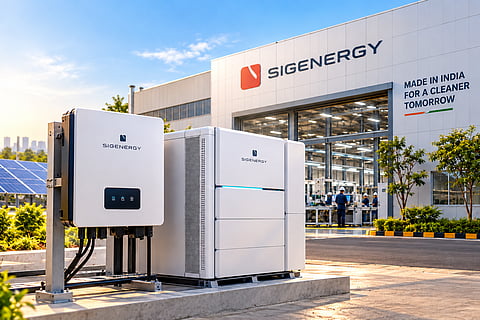
An India-based partnership between Failte Energy and China’s Sigenergy plans an initial investment of $250 million to establish manufacturing facilities for inverters and battery energy storage systems (BESS). Rahul Morde, head of sales at Sigenergy India, outlined the proposal in an interview with Reuters on October 23, 2026, at the Renewable Energy India Expo. The planned investment has not yet been detailed in a separate formal announcement identified on the companies’ public channels.
The proposed development is planned in phases. The inverter manufacturing plant is targeted to begin operations by the second quarter of 2027. A BESS manufacturing facility would follow, with commissioning expected six to eight months after the inverter plant becomes operational, according to Morde. The partners were still evaluating locations at the time of the interview, so the factory sites and production capacities had not been disclosed.
The proposal also includes a research and development centre in India focused on battery energy storage systems. However, the companies have not publicly specified the centre’s investment allocation, technical scope, staffing or timeline in the sources reviewed. These details will be necessary to assess whether the project will focus on system assembly, product adaptation, engineering development or a broader domestic technology capability.
Sigenergy’s official communication provides context for the proposed expansion. The company announced its entry into India through a strategic partnership with Failte, outlining a portfolio covering residential solar, commercial and industrial systems, utility-scale inverters and energy storage. It also described AI-based monitoring and intelligent energy management as part of its product offering. The company’s India-facing profile states a commitment to localisation, local assembly, and developing service and supply-chain capabilities. These are company-stated priorities, distinct from confirmation that the proposed factories have secured approvals or begun construction.
Morde also told that Sigenergy had complied with India’s requirements for storing data within the country and was seeking investment clearances. The reported compliance statement concerns data storage, while the manufacturing project’s investment approvals remain a separate matter. The available information does not establish that all clearances required for the planned facilities have been granted.
The next milestones are site selection, investment clearances and confirmation of plant capacities. Until the companies publish further details, the $250 million figure and commissioning dates should be treated as announced plans conveyed by a company executive, rather than completed investment or operational manufacturing capacity.