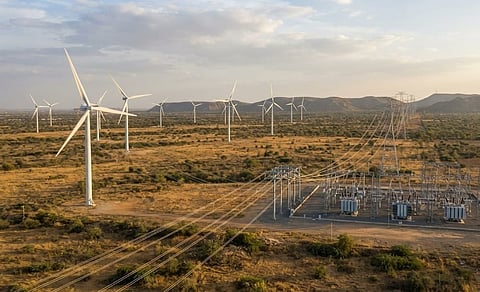
The Rajasthan Electricity Regulatory Commission (RERC) has upheld the liability of Shri Om Agro Products to pay relinquishment charges after the company surrendered part of the long-term open access capacity linked to its wind power project. The dispute involves a 1.5 MW wind power plant in Jaisalmer, of which 0.75 MW had been allocated for captive consumption at the company's manufacturing facility in Jodhpur. Rajasthan Rajya Vidyut Prasaran Nigam Limited (RVPN), the state transmission utility, sought ₹15,86,864 in transmission-related dues and relinquishment charges.
The company's decision to surrender the captive allocation followed a decline in its manufacturing activity and electricity requirements. According to the account of the proceedings, consumption at its Jodhpur facility eventually fell to zero. Shri Om Agro Products consequently sought approval to move the 0.75 MW allocation from captive consumption to a power-sale arrangement with the state's distribution utility. An amended power purchase agreement was executed in July 2024, allowing the electricity to be sold to the DISCOM at a preferential tariff.
The company challenged RVPN's demand on the grounds that the transmission infrastructure continued to be used after the change in the power-sale arrangement. Its argument was that the capacity had not become stranded because the distribution utility was receiving the electricity, and therefore the transmission utility had not suffered an actual financial loss. RVPN maintained that the early relinquishment of long-term open access rights attracted compensation under the applicable regulations, irrespective of the subsequent allocation of the power to a DISCOM.
The Commission's decision turns on Regulation 14 of the Rajasthan Electricity Regulatory Commission (Terms and Conditions for Open Access) Regulations, 2016. Under Regulation 14(2), a long-term open access customer relinquishing its rights before completing 12 years is liable to pay compensation calculated at 66% of the applicable transmission and wheeling charges for the period falling short of 12 years, subject to a maximum period of three years. The provision also addresses cases in which the customer gives less than one year's notice, prescribing an additional charge for the notice period shortfall.
As reported in accounts of the ruling, RERC treated the relinquishment liability as arising under the regulatory formula and did not make it dependent on RVPN proving that transmission capacity had remained unused or that it had suffered a specific financial loss. The subsequent conversion of the captive allocation into DISCOM power sales therefore did not, by itself, remove the liability arising from the early surrender of open access rights. The Commission upheld RVPN's demand and directed the company to clear the outstanding relinquishment charges.
The dispute had also affected the project's grid connection. RVPN ordered disconnection of the wind power plant from its pooling station in May 2025 after the company disputed the demand and did not deposit the charges. The reported ruling also upheld interim directions concerning partial payment and reconnection.
The decision highlights the contractual and regulatory implications of changing the use of renewable electricity after securing long-term open access. A generator may be able to redirect power from captive consumption to a distribution licensee through a revised power purchase arrangement, but that change does not automatically settle obligations associated with relinquishing previously secured transmission access. For renewable project owners, the timing of surrender applications and the remaining duration of open access rights can therefore have direct financial consequences.