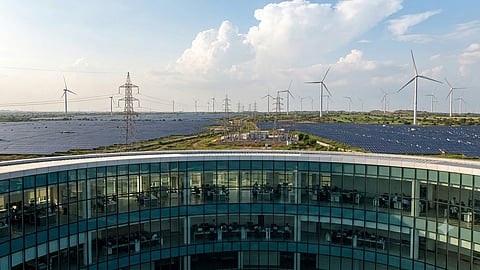
India's wind and solar generation reached a record 42.79% of total electricity supply, underscoring rapid renewable energy growth and the need for greater grid flexibility.
India’s power system achieved a significant milestone on July 13 as variable renewable energy (VRE)—comprising solar and wind—accounted for a record 42.79% of the country’s total electricity generation. Combined wind and solar output peaked at 103.7 GW, driven by strong monsoon winds across western India and robust solar generation.
The achievement reflects the rapid expansion of India’s renewable energy capacity. By the end of July 2026, the country’s installed solar and wind capacity is expected to approach 225 GW, including around 165 GW of solar and 57 GW of wind. Together, these technologies account for nearly 93% of India’s renewable energy capacity, excluding large hydro. With FY2025-26 adding a record 55.3 GW of non-fossil capacity, similar generation milestones are expected to become increasingly common.
However, the record also highlights the growing challenge of managing high shares of variable renewable energy. As renewable penetration rises, the focus is shifting from capacity addition to system flexibility. The Central Electricity Authority (CEA) has emphasised the need for greater deployment of energy storage, demand response mechanisms and faster-ramping conventional generation to balance the grid. On days when wind and solar contribute more than 40% of electricity generation, the remaining power system must manage daily ramps exceeding 100 GW between midday and evening peak demand.
The regulatory landscape is also evolving to improve grid discipline. Proposed regulations, scheduled to come into effect in April 2027, would impose stricter penalties on renewable generators that deviate from scheduled power generation. According to analysis by Equirus Capital, the revised deviation settlement mechanism could reduce project revenues by around 11% for solar projects and up to 48% for wind projects, making accurate forecasting and co-located energy storage increasingly critical for project viability.
The market is already responding to these changes. India’s battery storage pipeline has grown beyond 110 GWh, while storage-linked solar tenders and Firm and Dispatchable Renewable Energy (FDRE) projects have become central to SECI’s procurement strategy. Transmission utilities, including Power Grid Corporation of India Limited (POWERGRID), are also incorporating energy storage into network planning to enhance grid stability.
Curtailment is emerging as another critical issue as renewable penetration increases, particularly in high-generation states such as Rajasthan and Gujarat. These states are expected to reach local grid absorption limits ahead of the national average, placing greater reliance on interstate transmission infrastructure and timely commissioning of transmission projects. At the same time, distribution companies (DISCOMs) face the challenge of procuring flexible resources—including storage, demand response and market-based balancing products—without further straining their finances.
The record renewable energy share signals that India’s renewable generation targets are increasingly being achieved. However, the next phase of the energy transition will depend on the deployment of storage, grid flexibility, accurate forecasting and ancillary services to ensure renewable energy can be reliably integrated into the national power system.
